
Traditional Christianity (esp. Evangelical, Fundamentalist)
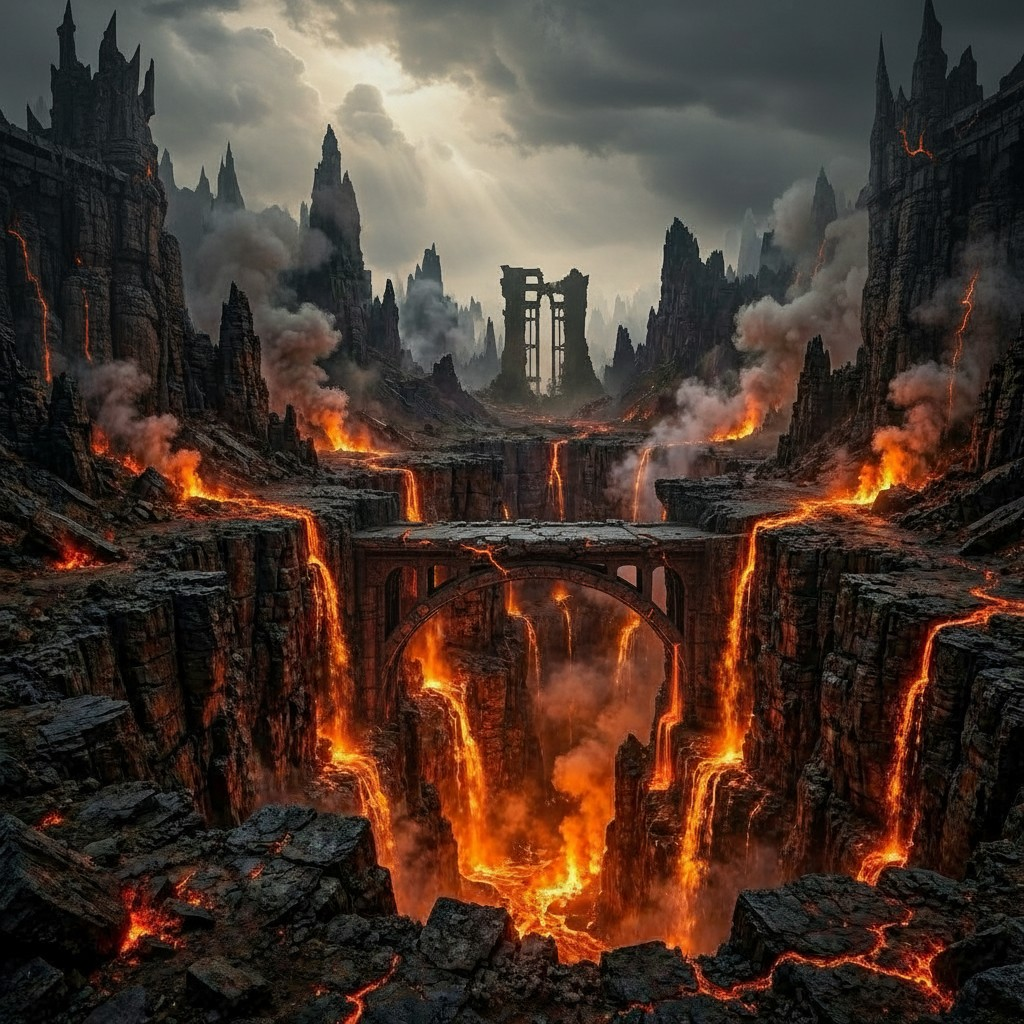
Fig. 1.1. A symbolic artistic interpretation of the traditional Christian conception of hell as a realm of divine judgment. The bridge, ruined gate, volcanic chasms, and descending light are symbolic elements rather than literal biblical descriptions. This illustration is a modern artistic interpretation inspired by the beliefs and texts discussed in this chapter and is not intended as a literal depiction of the afterlife.
Among all the conceptions of hell found throughout human history, none has become more widely recognized in Western culture than the image of an eternal realm of fire and brimstone. For centuries, countless sermons, paintings, hymns, books, and works of literature have portrayed hell as a place where the wicked endure unending punishment in flames prepared by God for Satan, his fallen angels, and all who reject divine salvation. This belief has profoundly influenced Christian theology and popular imagination, making fire the defining symbol of divine judgment. The biblical imagery behind this doctrine comes from both the Old and New Testaments. The destruction of Sodom and Gomorrah by "fire and brimstone" established an early image of catastrophic judgment, while the teachings of Jesus describe "the eternal fire," "the furnace of fire," and "the unquenchable fire." The Book of Revelation expands these images with its description of the Lake of Fire, where death, Hades, the devil, and those whose names are not found in the Book of Life are cast after the final judgment. Taken together, these passages have led many Christians to understand hell as a literal place of everlasting punishment. Supporters of this doctrine teach that hell demonstrates both God's perfect justice and humanity's moral responsibility. In this view, God offers salvation through Jesus Christ, but individuals remain free to accept or reject that gift. Those who persist in unbelief or rebellion ultimately separate themselves from God's presence and receive the consequences of that decision. Fire, therefore, is understood not only as physical torment but also as a symbol of God's holiness consuming all that is opposed to Him. Throughout the Middle Ages, artists and theologians expanded upon these biblical descriptions, filling churches with vivid murals of demons, blazing infernos, and condemned souls. Such imagery served both educational and moral purposes, reminding believers of the seriousness of sin and the reality of divine judgment. Revival preachers in later centuries continued this tradition, often using dramatic descriptions of hell to call listeners to repentance. Although this remains one of the most influential understandings of hell, it is not the only Christian interpretation. Some theologians argue that the biblical fire should be understood symbolically, representing complete separation from God rather than literal flames. Others believe the wicked are ultimately destroyed rather than eternally tormented. Nevertheless, the traditional doctrine of eternal fire and brimstone continues to be one of Christianity's most enduring and recognizable teachings, shaping religious belief, literature, art, and popular culture for nearly two thousand years.
The doctrine developed from Jewish concepts of divine judgment and Gehenna, was further articulated by early Church Fathers, expanded during the medieval period, and became firmly established in much of Western Christianity. During the Protestant Reformation and later evangelical revival movements, vivid preaching on hell emphasized personal repentance and salvation through Christ.
Few religious ideas have influenced Western art and literature more profoundly than the traditional Christian image of hell. It inspired medieval cathedral murals, Renaissance paintings, morality plays, revival sermons, novels, poetry, films, and countless cultural references. Even the common expression "fire and brimstone preacher" reflects the lasting impact of this doctrine.